Master sales with the playbooks elite closers use
What to ask, what to answer when they push back, how to state your price and how to ask for the decision. The Sales Mastery Playbook takes a one-to-one sale from the first hello to the referral, with the words for every turn, and four bonus playbooks to work from.
Buy nowPDF download right away · 3-day money-back guarantee
These six sentences have cost you sales
Each one can end the conversation or keep it going. What decides it is the next thing out of your mouth.
With the battery inside the frame, this one's easier to lift than its neighbor.
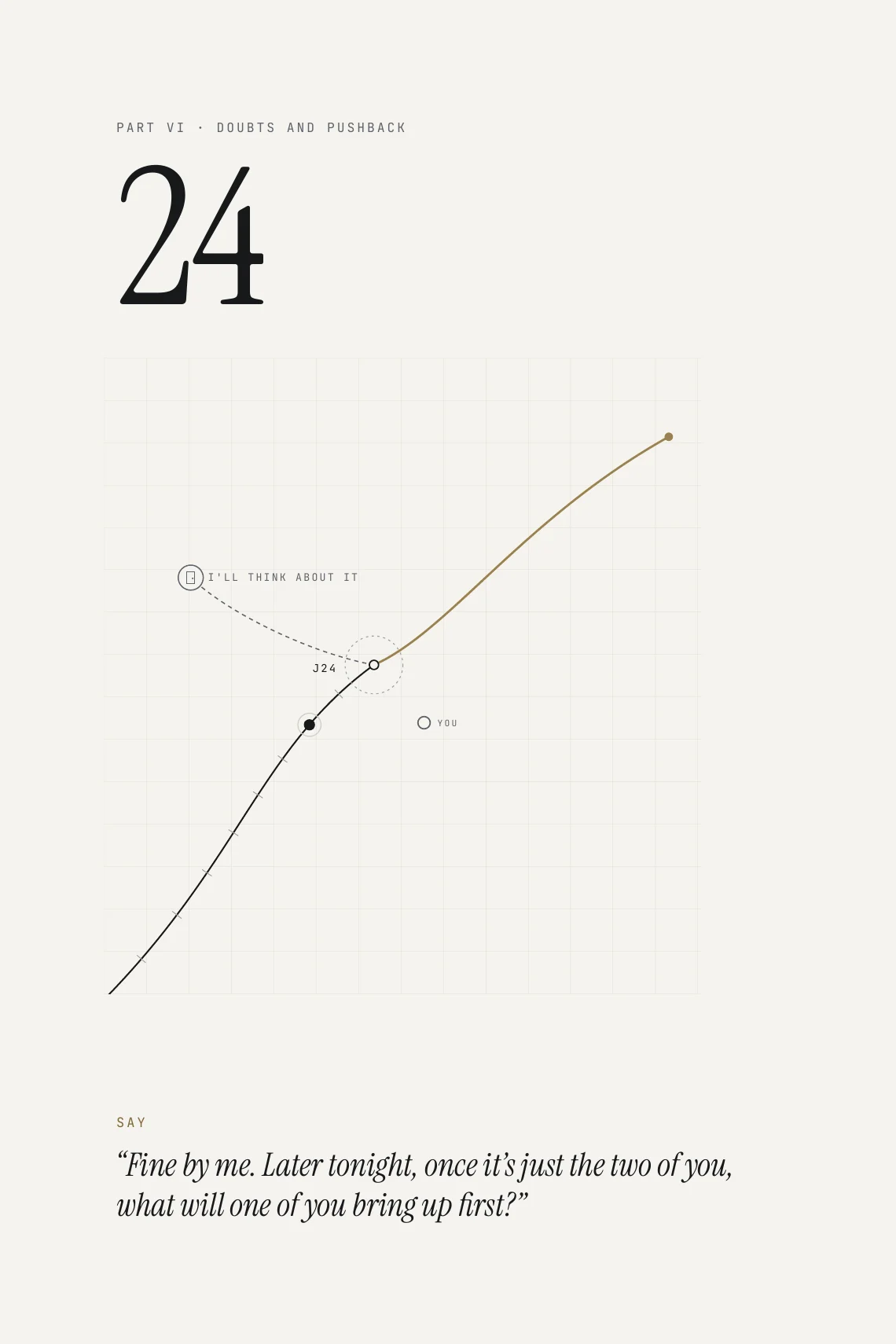
Fine by me. Later tonight, once it's just the two of you, what will one of you bring up first?
Sure thing. What will you be comparing it against, so I send you something useful?
The boats stay at that price. Buy your paddles and jackets from us, though, and I'll put the rack on and walk you through the straps.
Could I see their quote? It might not cover the same work.
Would you like me to hold a Tuesday slot for you, or shall I close the file for now? Both answers are fine.
The lines come from scenes in the book, each set in a particular trade. Swap a word or two and they fit yours.
Nobody hands you a manual when you start selling.
You copy whoever seems to close, watch a few videos, and learn the rest by losing deals. That leaves you with a handful of lines that work and no map of how a sale hangs together. This book is the map. It follows one sale from the first contact to the referral, shows why each stage works the way it does, and gives you the words for the moments that decide it.
The book + 4 bonus playbooks
Objection Scripts alone answers 26 objections, each with the line to say and what comes next.
One chapter, as it's printed
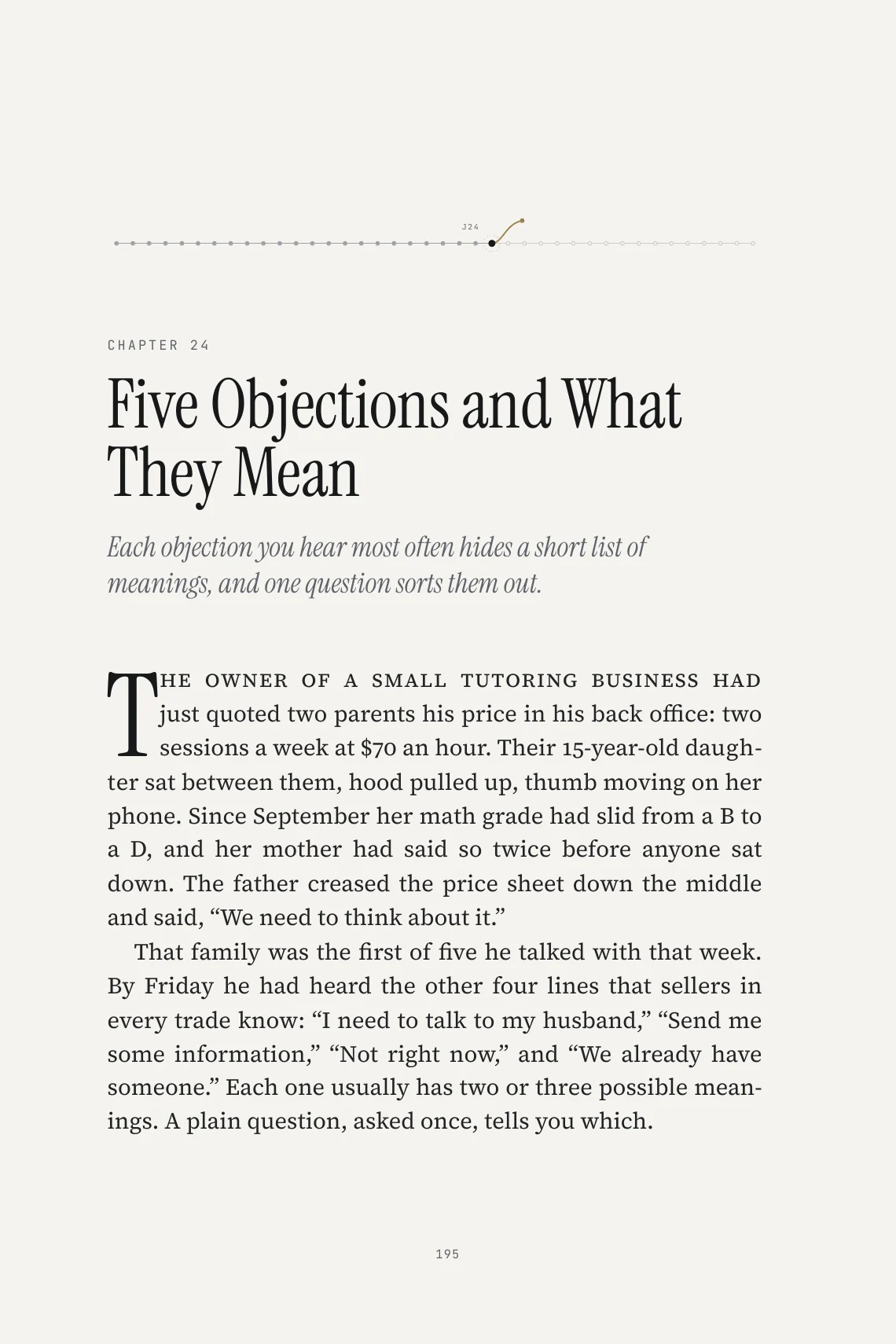
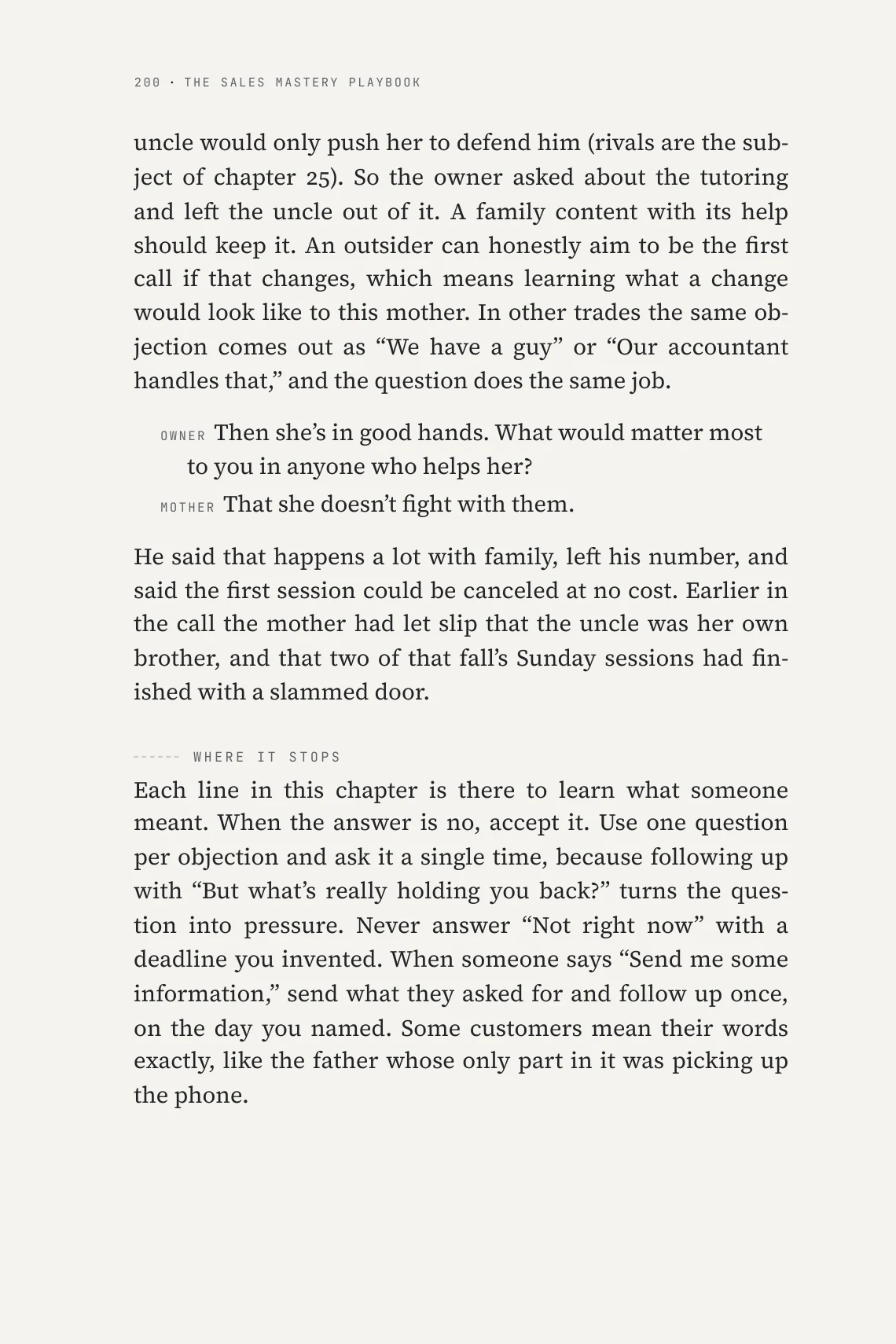
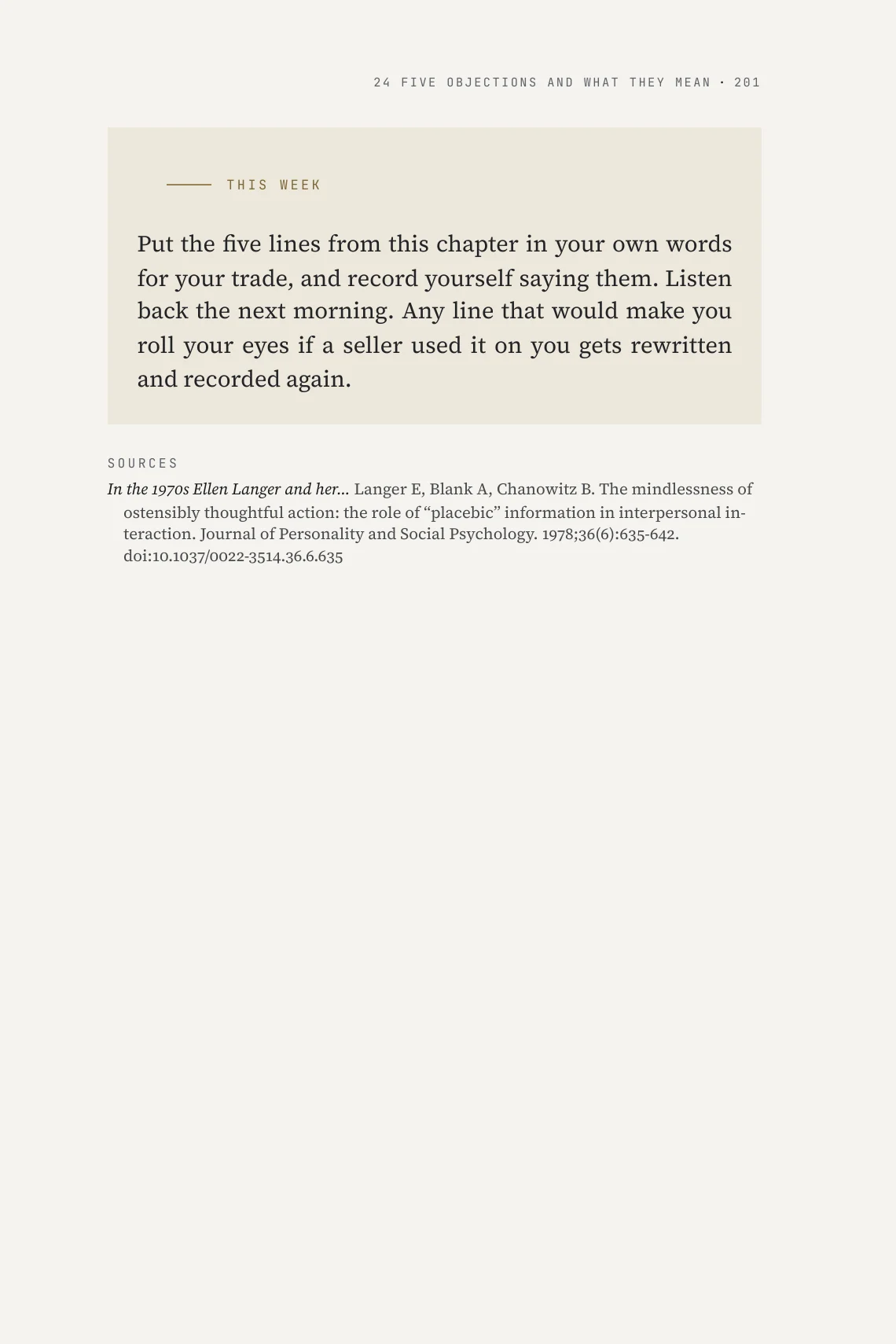
Chapter 24, “Five Objections and What They Mean”, takes the five sentences sellers hear every week, starting with “We need to think about it.” Here are its first two pages and its last two.
A whole sale, stage by stage
Eleven parts, in the order a sale unfolds. Read it through once to see the whole job. After that, open the part for the stage where your sales stall: chapter 04 lays every stage beside the part that covers it. A chapter is about a six-minute read.
Just looking.
You talk, they nod, and nothing happens.
They like it, but can't see why it's worth it.
I need to think about it.
Your voice drops when you say the price.
Can you do better on the price?
You never quite ask for the yes.
The quote goes out, then silence.
The Basics of a Sale
What a sale is, why buyers stay put, how trust is earned, and where influence turns into pressure.
Finding People to Sell To
Choosing the customers you serve best, reaching a stranger, asking for introductions, and getting ready for the call.
Opening the Conversation
First words that get an answer, rapport that isn't an act, and agreeing up front how the meeting will run.
Finding Out What They Need
The next question to ask, listening they can see, the cause under the symptom, who can buy, and who decides.
Showing What It's Worth
Showing only what this customer needs, letting them try it, evidence they can check, and naming the flaw yourself.
Doubts and Pushback
Telling an objection from a stall or a condition, one way through any objection, the five you hear weekly, and a cheaper rival.
Talking Money
What your price gets compared with, saying the whole figure, when a discount is worth giving, and laying out options.
Give and Take
Your numbers before you sit down, trading instead of conceding, and selling when a group decides.
Asking for the Decision
Asking plainly when they're ready, stopping at yes, and taking a no so the door stays open.
Once They've Said Yes
The days after the sale, following up on a quote without nagging, and the customers who come back and send others.
Working on Yourself
Which channel suits which moment, the few numbers worth tracking, and drills, reviews and counting your nos.
One to three per chapter, each true when you say it and short enough to say in one breath.
Every chapter closes on one practice for your next conversations, after saying where its advice stops working.
The trade's jargon in plain English at the back, and every study a chapter leans on named with its source.
The book + 4 bonus playbooks
40 chapters in 11 parts, 63 key terms, and a source behind every study.
The book teaches the job. The bonuses go to work with you.
Keep them beside the phone, print one before a call, fill one in after it. Four PDFs, 90 pages on US Letter, built from the book's own lines and practices, each pointing back to its chapter and page. They come with Book + Bonuses, or on their own.
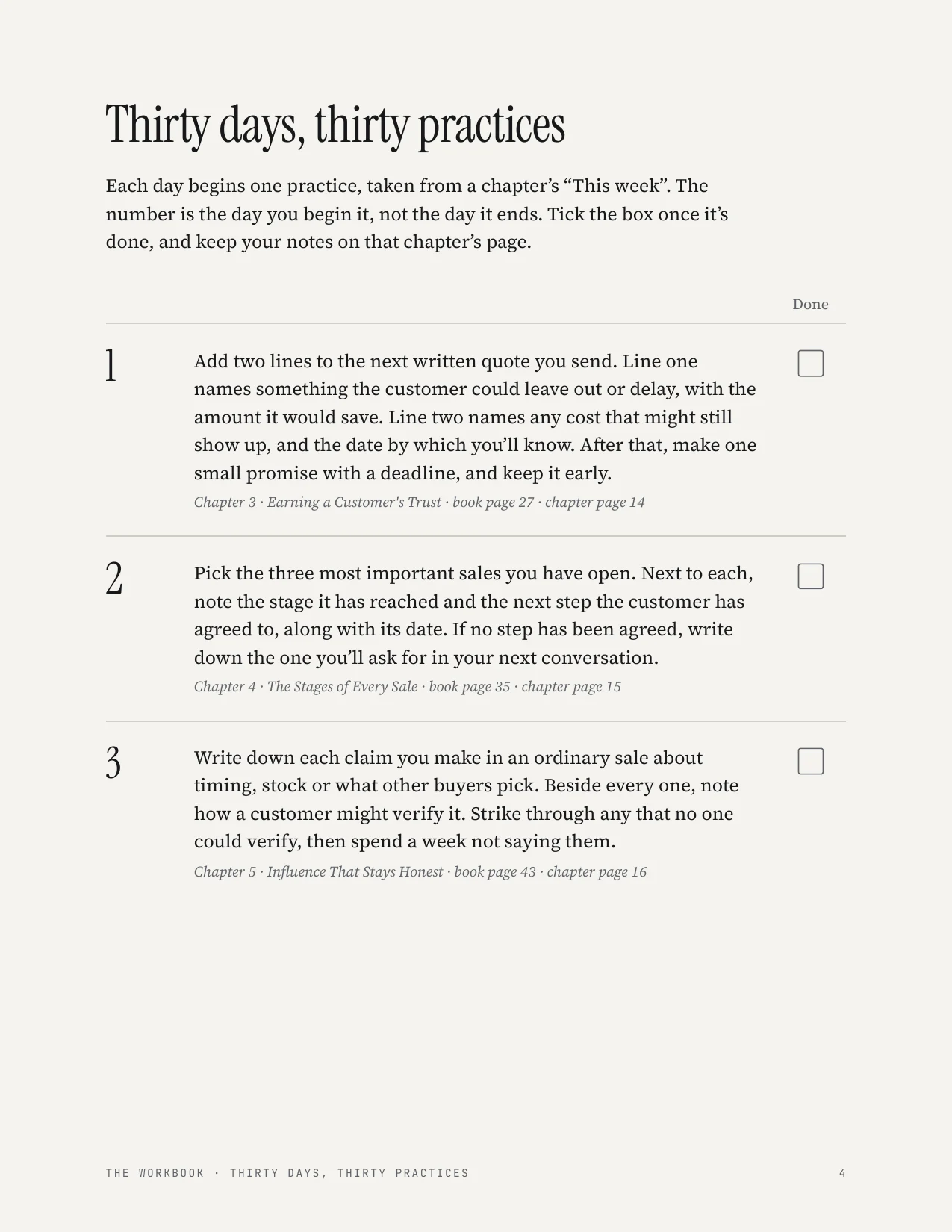
The Workbook
Turns the book into practice in your own conversations, starting the day you read it.
- Thirty days, thirty practices: one to begin each day, with a box to tick
- One page per chapter: what it teaches, what to try, and space for notes
- Your conversation record: a few lines on every conversation worth tracking
- Lines in my words: the book's lines, rewritten for your trade
- The three-month review: what a quarter of numbers shows
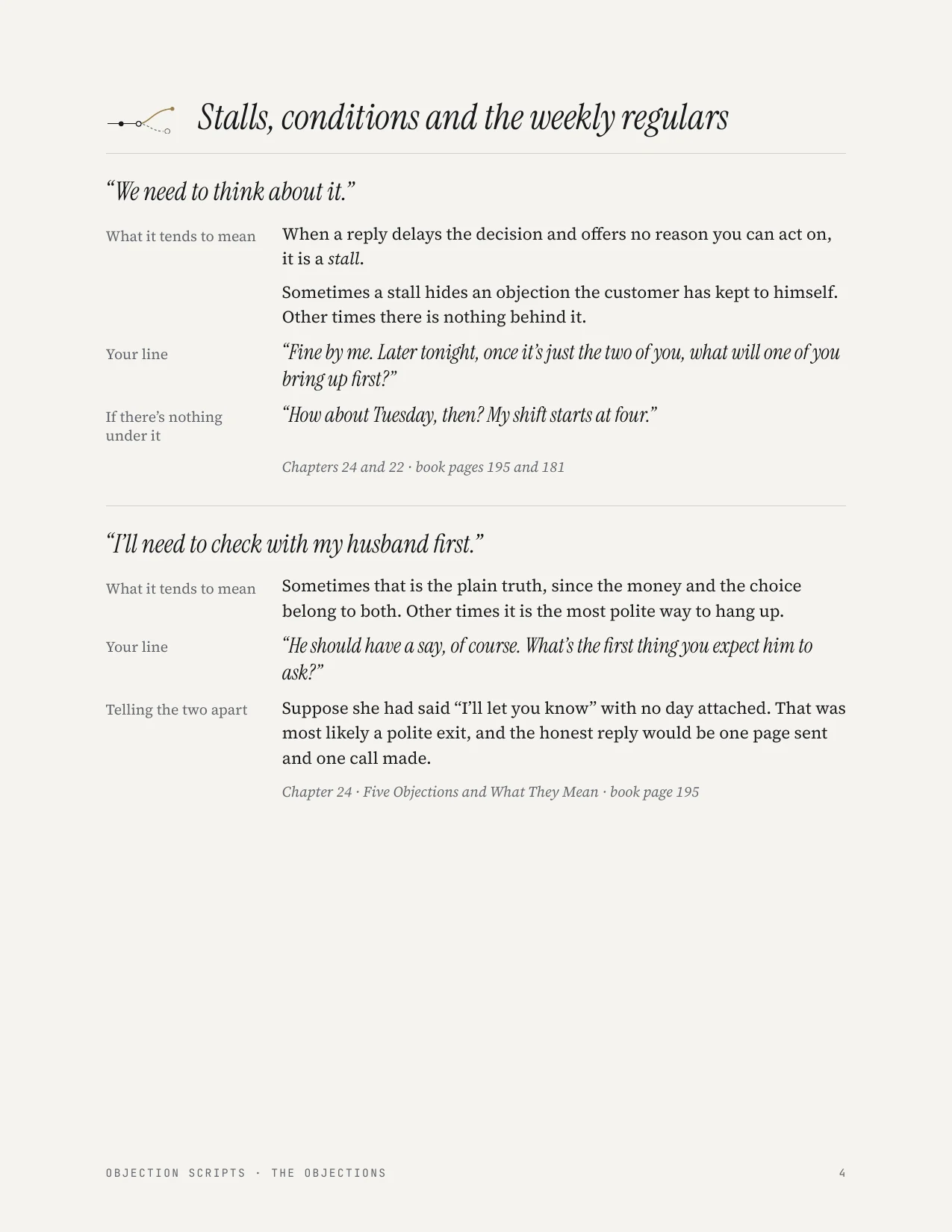
Objection Scripts
Know what “we need to think about it” usually means, and what to say next.
- The 26 objections the book handles, each in its own words: what it tends to mean, your line, and what to do next
- Three kinds of reply told apart: an objection, a stall, a condition
- When yours isn't listed: the sequence that works on any objection, and where to stop asking
- Every entry gives its chapter and the book page it opens on
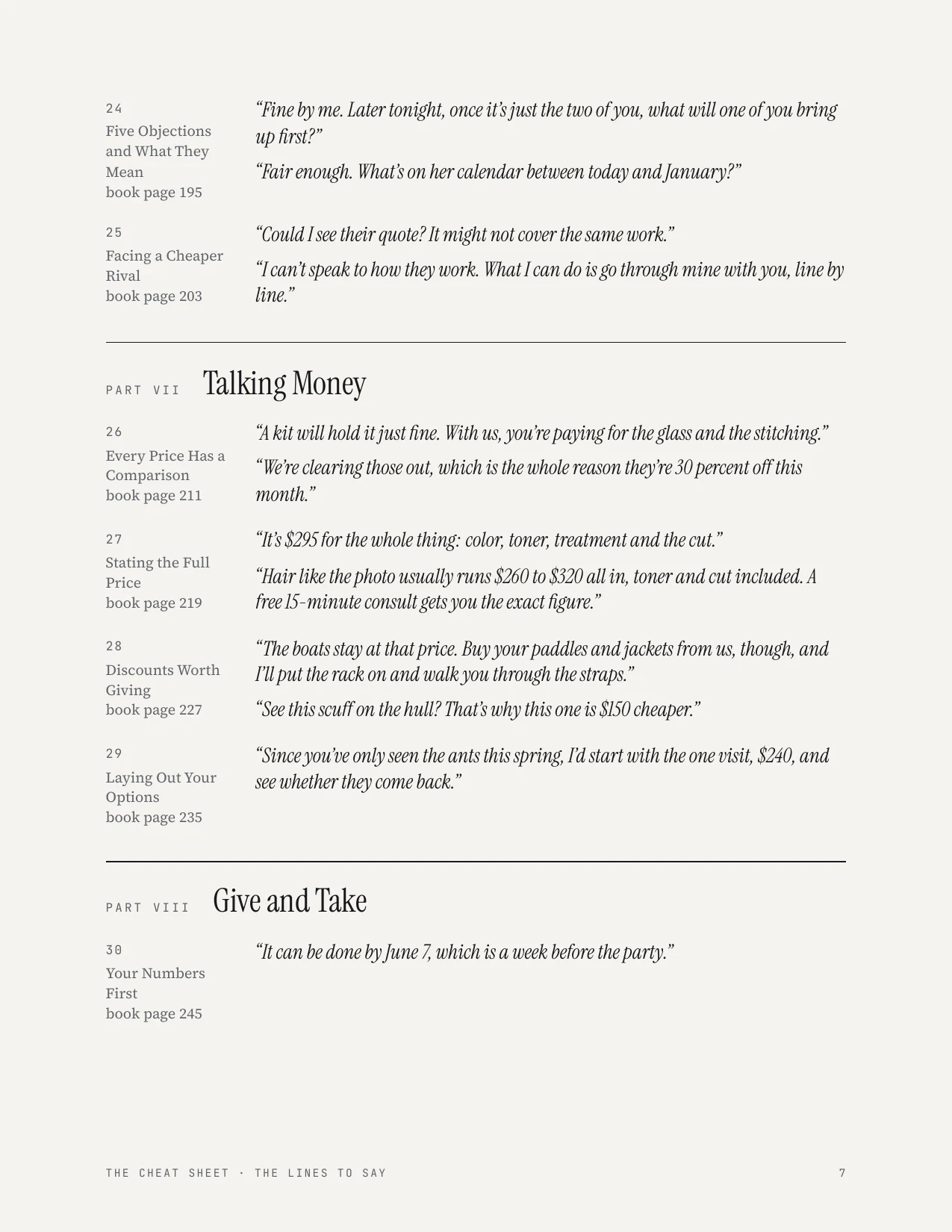
The Cheat Sheet
Every line to say in the book, quoted exactly, in one place.
- All 83 lines in book order, part by part, so the lines for one stage of a sale sit together
- Each under its chapter and book page, to read the conversation it belongs to
- Print the page for the stage you're working on, or keep it open on your phone
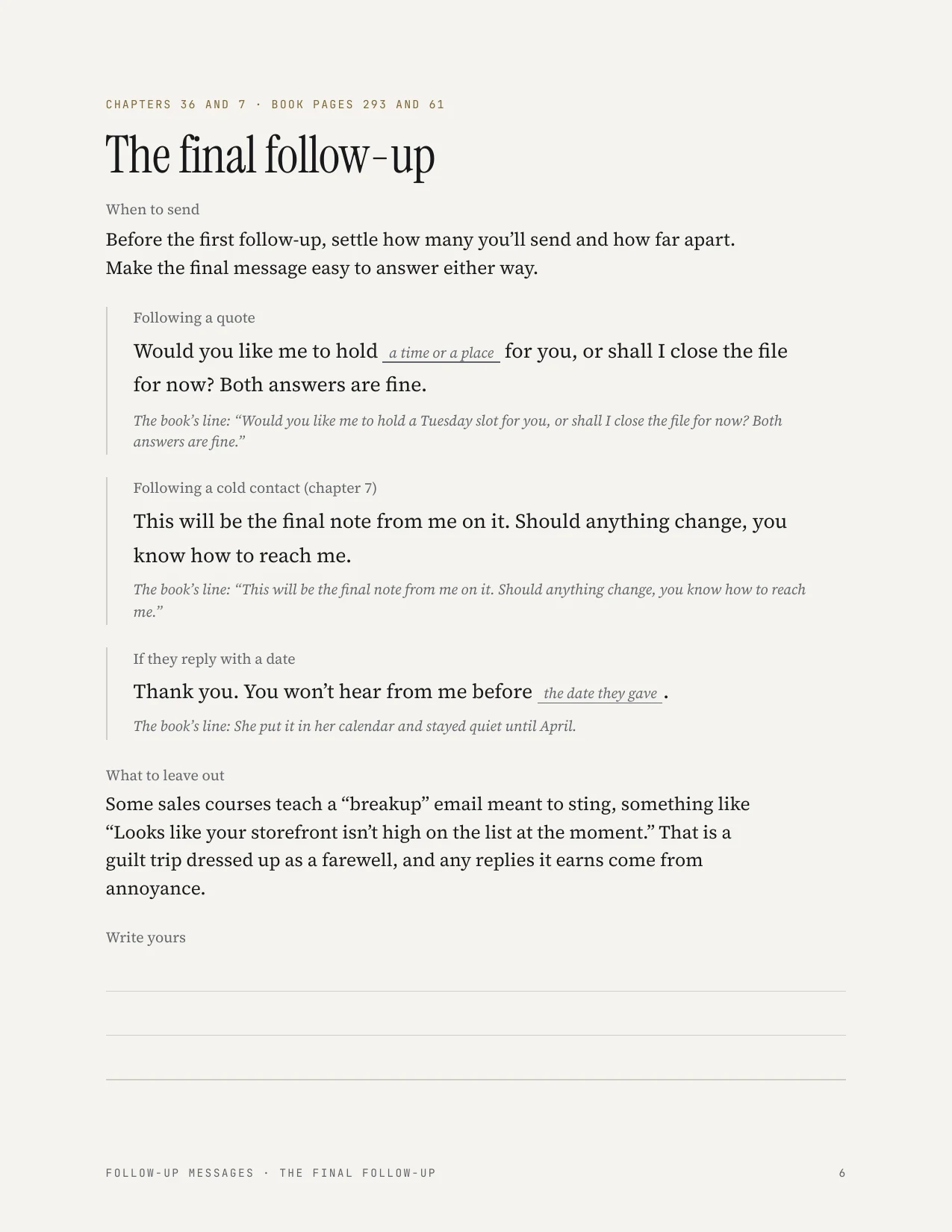
Follow-Up Messages
Know what to send after the conversation, and when to stop.
- Seven moments: after you quote, the final follow-up, when the answer is no, once they've bought, saying thank you, asking to be introduced, and reporting back to whoever referred them
- Messages with blanks for the customer's own facts and words, the book's line printed under each
- Lines to write your own version, and when to leave a message unsent
Is it for you?
It's written for one kind of seller. Better to know before you buy.
Yes, if
- You sell face to face or one at a time: across a counter, on a car lot, at a viewing, in a quote, on a discovery call.
- You were never trained, or this is your first sales job.
- You'd rather understand why a line works than memorize it.
- Lines that sound rehearsed make you cringe.
Not if
- You're after pressure tactics. Nothing in the book works by misleading anyone.
- You sell to many people at once: ads, funnels, shelves, packaging.
- You run a sales team and want a book on managing one.
Pick your plan
One payment, no subscription. Everything downloads the moment you've paid.
Secure Stripe checkout · Apple Pay · Google Pay · card
back
Money-back guarantee
Open the part that matches your next conversations and read it. If nothing in it changes what you'll say, reply to the email your files came with, within 3 days, and you get every dollar back. No form to fill in, no reason asked. support@salesmasterysecrets.co
Questions
I've read sales books before. What's different here?
Most sales books sell one method or a pile of tips. This one walks the whole job in the order a sale happens, and every chapter does three things: explains why something works, gives you the words, and tells you where the advice stops holding.
Isn't this about pushing people into buying?
No. Chapter 5 sets one test for every technique in the book: would it still work if the customer could see everything you know? Anything that fails it is left out. No invented deadlines, no fake scarcity.
Will it work for what I sell?
If you sell to one person or a small group at a time, yes: a store floor, cars, phones, homes, a freelancer's quote, a coach's first call, a small business buying from you. The scenes come from many trades on purpose.
I'm new to sales. Can I follow it?
It was written with you in mind. Short sentences, and each term the trade uses is explained the first time it appears and again in the key terms at the back.
Won't I sound scripted?
The lines are short and true, and the book expects you to say them your way. Chapter 40 is about rehearsing out loud, and the Workbook's “Lines in my words” pages are where you rewrite each one for your trade.
Why should I trust it?
Because you can check it. When a chapter rests on research, it names the researchers, says what they tested and what they found, and gives the source at the end of the chapter.
I don't have time for a whole book.
You don't need to read it in order. A chapter takes about six minutes. Open the part for the stage that costs you the most sales, or read the Cheat Sheet and follow its page numbers back.
Is $17 worth it?
Only you know what one sale is worth to you. If one chapter keeps a single customer from walking out on “I need to think about it”, it has covered itself, and the guarantee covers you if it doesn't.
What do I get?
PDFs. The book is 335 pages at 6 × 9 in, readable on a phone and printable on Letter or A4. Book + Bonuses adds the four bonus playbooks: the Workbook (59 pages), Objection Scripts (11), the Cheat Sheet (9) and Follow-Up Messages (11), on US Letter.
Do I need a printer?
No, everything works on a screen. The Workbook is made to be written on, so print it, or just the pages you're using. On A4, choose “fit to page”.
How do the files reach me?
On the page that opens as soon as you've paid, and by email too. Payment is through Stripe: card, Apple Pay, Google Pay or Link.
How do refunds work?
Reply to the email your files came with, within 3 days of buying, and you get every dollar back.
Someone will say “just looking” to you this week. Have your answer ready.
Open the part for the conversation in front of you, print the Cheat Sheet, and try one line before Friday.
Buy nowPDF download right away · 3-day money-back guarantee